We who with songs beguile your pilgrimage / And swear that Beauty lives though lilies die, / We Poets of the proud old lineage / Who sing to find your hearts, we know not why ... (James Elroy Flecker)

3.12.21

The Cheshire Cat on Himself

 The Cheshire Cat on Himself

(with running commentary from human observer)


Mr Carroll (better known to me as Reverend Charles) forgot to mention that I am the breed of cat known as Burmese. We love to climb, are good at it, and unlike some other felines do not get stuck up trees and wail to be brought down. We like it high – and can come down when we care to, e.g. for food.


‘I’m agile, adept’ –

his feline smirk declares

from a lofty branch


It’s true that now you see me, now you don’t. I am indeed the disappearing cat – according to my whim (which means my needs). There are people who swear I dematerialise, then eventually re-materialise, appearing suddenly just when they are certain I have vanished forever.


where has that cat gone?

– oh! where did he come from?

he keeps his secrets


The Reverend got it right about my wisdom. I am the observer, through which I have learned much. Alice was an impulsive child, needing guidance. At least she had sense enough to listen to me, if not often the patience to understand what I was trying to explain. One can but try!


he slow-blinks riddles –
his air inscrutable

yet self-satisfied


What about my famous grin, which successive generations of artists always draw full of menacing teeth? Cats can and do grin with open mouths, but usually in fun. (Otherwise it’s a snarl.) Mine, while cheerful enough, was more of a knowing smile behind closed lips. And still more than that – it was an air, an emanation, a mood conveyed by my whole being. Of course it lingered, even after I removed my bodily self. 


this cat’s expression 

says he has mastered life –

others may ponder


Image  from Unsplash, by Alejandra Coral


Written in response to Friday Writings #5 at Poets and Storytellers United, where Rommy invites us to reveal the point of view of a secondary character in fiction.

19.11.21

Beyond the Black Stump

 Beyond the Black Stump


You want to know what it’s like out there? I can tell you. I’ve been. A few times.


You’ll hear different things from different people. Some will tell you of our native drop bears, their dangerous habit of dropping straight down out of trees onto unsuspecting travellers. (Don’t walk under the trees!) Or the bunyip calling from some lonely waterhole to entice you in. (You won’t come out again.)


Some will warn you about wild dingoes – which might sound more mundane, more believable. But though they look like dogs, they’re far from tame. Or you’ll hear about herds of marauding camels which could rampage through your campsite any night. And snakes and scorpions, too.


You'll be told to take much more water than you think you’ll need. A car repair kit would be handy as well. Also a good blanket; the desert nights are freezing. They’ll say, tell people where you’re going: your route, your destination, your ETA. They'll tell you over and over: if you break down, never leave your car. No-one will ever find your body out there.


Yarns to scare the tourists? Only one of those things isn’t true. 


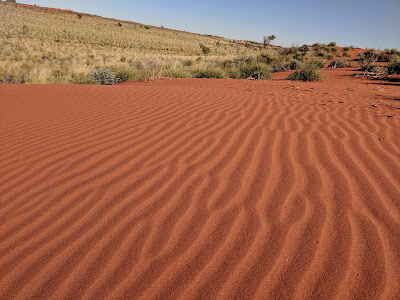
Someone might mention the deep red earth, stretching flat in all directions; the grey-green scrub; colourful rocks rising suddenly out of nowhere in gigantic curves; anthills as big as trees; the white bark of the ghost gums.


The silence of the desert night. Impossible crowds of stars, so clear in that enormous sky.


If they went through in a good year, they’ll have seen evidence of rain – birds thronging the pools (water in the pools!), flowers blooming in the scrub.


They might describe a natural spring, deep outback where you’d never expect to find any such thing – skin temperature, surrounded by lush vegetation, deep and wide enough to swim.


Perhaps someone will whisper of rock paintings so old no-one knows their date; of special rituals for greeting the earth in particular places; of the spirits of ancient elders who might appear; of a mighty rainbow serpent … or mutter about mines wounding the land.


Tales to dazzle visitors? Only one thing I’ve listed is a lie. (It’s not the bunyip. It’s not the rainbow serpent.)


Written for FridayWritings #3 at Poets and Storytellers United, to the prompt: 'Describe the scenery beyond the black stump' – which should speak to Aussies in particular.

Photo of outback Queensland by Greg Spearritt, on Unsplash.


12.11.21

Metamorphosis

Metamorphosis

The first and best thing I learned

at home and then at school

was the magic of the written word.


Perhaps it was inborn –

the family all great readers

and gave me books for my birthdays.


                 ************


(Now that I’m old it’s my son

who gives me books, always knowing

perfectly those I’ll love.


When he was little, I read to him

all the time. Like me in my childhood,

when he learned to read for himself


he disappeared from this world

into the words in the books,

only his quiet body still sitting here.)


               ************


Of course I became a poet.

Of course I became a witch.

Of course I learned all the words


for being me, all the words for life 

all the words for love. Of course 

I became all words.


Written for Friday Writings #2 at Poets and Storytellers United, where we were invited to write about something we learned at school.


3.11.21

Oral Cravings

Oral Cravings


When I was in group therapy

(back in my twenties)

one teenage girl was sad

because she was plump.

She thought no man

would ever want her.


‘Don’t worry, Tammy,’

a young chap said. ‘Some men 

say they love fat women.’

The therapist concurred. 

(I wasn’t concerned. I was 

a smoker, which kept me thin.)


‘Be careful,’ said the man

who ran the Smokenders course.

‘Ex-smokers often turn into

secret sweet-eaters.’ Too damn bad,

I thought. I was already 48

(I quit on my birthday).


‘If you don't stop 

by the time you’re 50,’

a doctor told me years before,

‘you WILL get lung cancer.’

So I did, and I didn’t. Luckier,

perhaps, than I deserve.


A few years ago, they thought I had 

emphysema. Turned out not.

It was the mould in my unit – now

thoroughly cleared. My breathing

is very much better. I got away

with all those years of smoking!


32 years in fact. But I’ve not become

entirely pure. ‘I’m a poet. Smoking 

helped the creative process,’

I told the Smokenders man.

He didn’t scoff. ‘Oh yes,’ he said,

and explained the brain chemistry.


‘Suck glucose instead,’ he advised me.

I took the advice. Also I didn’t (until 

years later) stop writing my poems

with a pen dipped in wine – as I 

used, so wittily, to say. There are

consequences. You can see them.


‘What happened?’ asked a friend,

comparing the me in front of her

with slim, glamorous younger photos.

‘I stopped smoking,’ I said, ‘at just

the same time I hit menopause.’

(Didn’t mention glucose ... or chocolates….)


I’ve been lucky, though.

No lung cancer, no emphysema.

I do have arthritis now, and so

I need to get slimmer for that. I’m trying!

But I do attest that there are indeed men

who will happily embrace a fat woman.


For Friday Writings #1 at Poets and Storytellers United, Magaly invites us to write about food. But we don't have to. Perhaps that's just as well, as this addresses the subject somewhat indirectly.


26.10.21

Goodbye Childhood

Goodbye Childhood


This is Julie, the sleeping doll I got for Christmas when I was seven.


Actually, that’s not true. The one I got was dressed in pale green, my mother’s favourite colour. I was so disappointed that I cried. My favourite colour was blue. My father hastened back to the shop to try and change her. (It stayed open Christmas morning just for that reason.) Luckily he could. Then I was happy.


I loved Julie dearly, and used to walk her in a little toy pram. She came without underwear! I made her some black panties. They weren’t very glamorous; they were square, seams tacked together in white thread (I didn’t have black). But she wore them forever after, under her pretty clothes. I couldn’t comb her hair; it was glued to her head in a mass, no strands to separate.


Mum said later how sad she was that it was so soon after the war (World War 2) that we still felt the effects of rationing. China dolls weren’t available. Julie had bakelite limbs and head and a rag body stuffed with something that felt like stiffly packed chaff. I didn’t care. No basis of comparison! I thought she was beautiful.


Originally there was lace around her bonnet. Several decades later, she looked shabby, and almost bald (that hair disintegrated over time). She’d lost the booties that matched her bonnet. A crafty friend gave her new hair and booties. I sat her by my bed. She shouldn’t be hidden away, I thought.


Years after, in a recent decluttering, I took a good look at her. High time I washed those clothes again! I took off her bonnet. It was thickly lined with bits of hair that had come away. In the wash, the ribbons on her dress fell to pieces. Her cloth body felt lumpy. Her stumpy bakelite fingers showed some knocks. 


I’d sometimes contemplated selling her to an antique shop. But who’d want this war-time baby in her deterioration? 


I hadn’t cuddled her in a long time. I’d let her get dusty.


So much for sentimentality! Julie and her clobber, even the black panties I lovingly made her when I was little, all went into the bin.


Written for Weekly Scribblings #93 at Poets and Storytellers United, where we're asked to write about something we loved as a child.


21.10.21

Senryu Morning


Senryu Morning


damn bird

wakes me early –

the old bones ache


*********


noisy bird

wakes me – or is it

the bladder?


*********


shrill bird

wakes me – or the cat

scratching?


#########


damp morning –

huge bird poo

on my driveway


*********


out my door –

wet ground grey sky

silence